

Pipeline
Precision therapies currently in development
Validation Through Partnerships
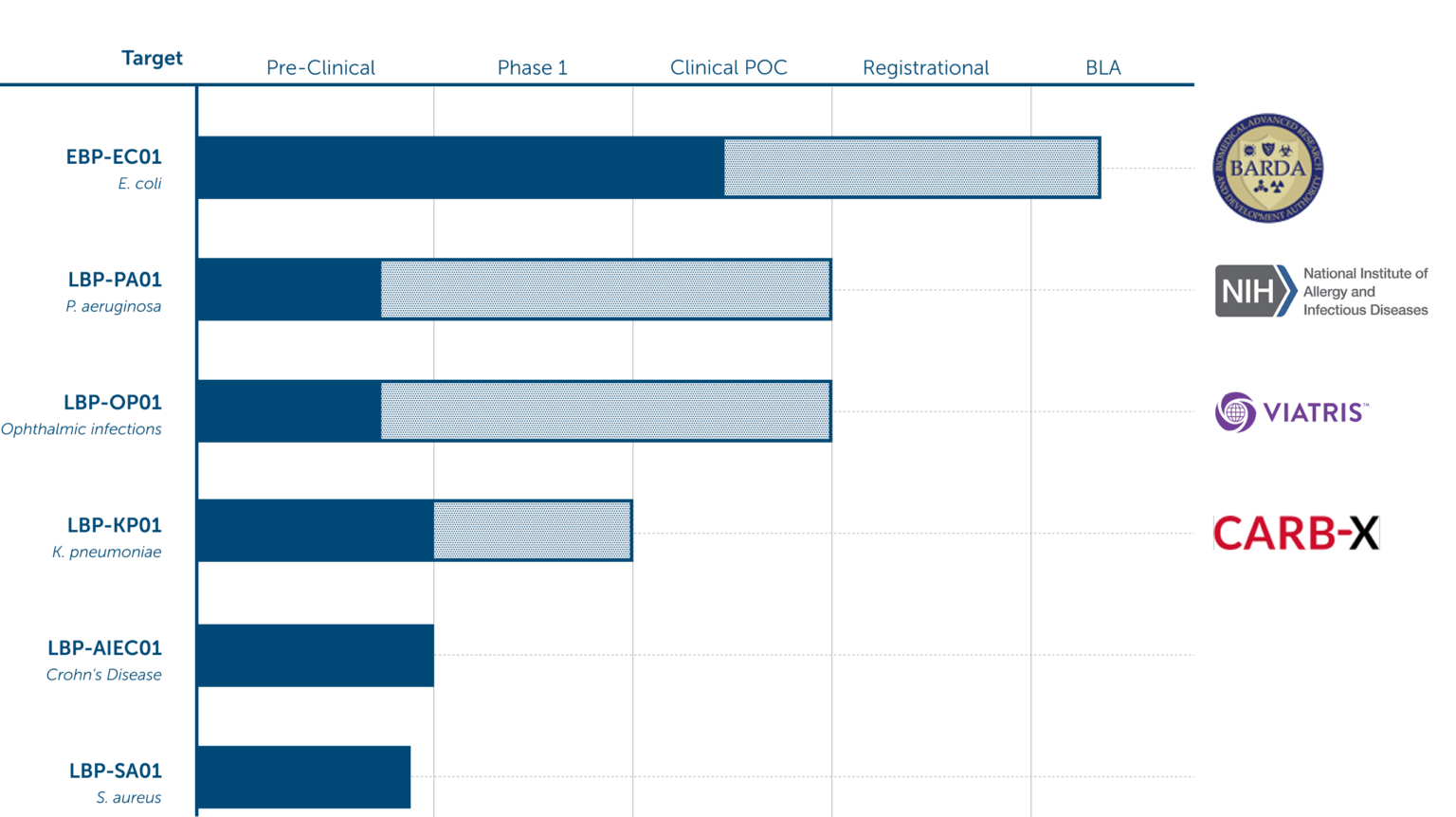
GUARDIAN is a clinically validated platform combating the world’s deadliest drug-resistant bacterial threats. We are currently developing treatments for 4 of the top WHO and CDC priority pathogens and more. Our scalable pipeline is supported by government and private partners, setting the foundation for rapid threat response.
$300M+
Total Funding Mobilized

Current State

Funded Scope of Current Contracts
LBP-EC01
LBP-EC01 is a precision medicine designed to target E. coli infections. It is an engineered bacteriophage product to precisely remove E. coli bacteria in patients with urinary tract infections (UTIs).
More about bacteriophages
More about phage therapy
Worldwide, an estimated 150 million people are affected by UTls each year. Approximately 80 percent of these are caused by E. coli, often including difficult-to-treat strains that are resistant to commonly used antibiotics. Nearly 40 percent of patients with UTIs experience a recurrence within months of the first episode. Both the U.S. Centers for Disease Control and Prevention (CDC) and World Health Organization (WHO) have identified antibiotic-resistant E. coli as an urgent and serious public health threat requiring development of new treatments.
Locus has partnered with Biomedical Advanced Research and Development Authority (BARDA), part of the Office of the Assistant Secretary for Preparedness and Response at the U.S. Department of Health and Human Services (HHS) to develop LBP-EC01. Up to $109 million provided by BARDA will help advance clinical development of LBP-EC01 through late stage clinical development and the marketing authorization process defined by the U.S. Food and Drug Administration (FDA).
Locus is currently enrolling patients in the ELIMINATE trial, a landmark registration-enabling Phase 2/3 trial testing LBP-EC01 in acute uncomplicated UTIs caused by MDR E. coli.
LBP-PA01
LBP-PA01 is a precision medicine designed to target P. aeruginosa infections. It is an engineered bacteriophage product to precisely remove P. aeruginosa bacteria in patients with pneumonia.
Hospital-acquired pneumonia (HAP) and ventilator-associated pneumonia (VAP) affect a combined 400,000 people per year in the US, with HAP affecting approximately 3-4 times more individuals than VAP. Bacterial HAP/VAP often develops from gram negative organisms including P. aeruginosa, with drug-resistant forms being of particular concern as they often lead to worse clinical outcomes for impacted patients.
Locus has partnered with the National Institute of Allergy and Infectious Disease (NIAID), part of the U.S. National Institutes of Health to develop LBP-PA01. Up to $28 million provided by NIAID will help advance clinical development of LBP-PA01 through clinical proof-of-concept.
LBP-OP01
LBP-OP01 is a precision medicine that targets ophthalmic bacterial infections.
Locus has partnered with Viatris Inc. (NASDAQ: VTRS) to develop precision antibacterial therapeutics for serious eye infections, an area of high unmet medical need due to the rise in antibiotic-resistant infections worldwide.
LBP-KP01
LBP-KP01 is a precision medicine designed to target K. pneumoniae infections. It is an engineered bacteriophage product to precisely remove K. pneumoniae bacteria in patients with complicated UTls.
There are 3-4 million complicated UTIs diagnosed in the US annually, which account for more than $6 billion in healthcare costs.
Locus has partnered with CARB-X to advance the development of LBP-KP01. CARB-X accelerates global antibacterial innovation by supporting the development of new antibiotics and other life-saving products to combat the most dangerous drug-resistant bacteria.
LBP-AIEC01
Adherent-invasive E. coli (AIEC) bacteria colonize the intestines of patients with Crohn’s disease, driving a cycle of epithelial cell damage and inflammation that exacerbates the disease. LBP-AIEC01 is a precision medicine designed to eliminate AlEC bacteria and disrupt this cycle.
According to the Centers for Disease Control and Prevention, there are an estimated 3.1 million adults in the US that have been diagnosed with inflammatory bowel disease (IBD). The majority of IBD cases are either Crohn’s disease (1.3 million) or ulcerative colitis (1.6 million).